How to Choose the Best Prep Program for Your Child
- Resources
Choosing a prep program is a tough decision. As parents, we want to get it right because a strong Prep year can help shape the path of our child’s learning through the primary years and beyond.
While it’s easy to be distracted by literacy and numeracy benchmarks, and by searching for the place you think will give your child the best academic start, there are some important human and holistic elements to think about, too, when deciding which is the best prep program that will most suit your child.
Montessori teachers who work with young children every day will tell you that what impacts a child most in those first years is not how fast they learn to read, but what helps shape them as a learner and a person.
Confidence, independence, curiosity and the willingness to give something a go – even when something feels hard –are critical skills which begin to form during Prep and continue to develop after those early years.
To answer some of the questions families often have when choosing the best prep program, we sat down with Noemie Ventajou, one of our experienced Junior School educators. She has spent years observing 3 and 4-year old Kinder and Prep classrooms and offers some grounded insights .
Five Questions to Ask to Help You Choose the BEST Prep Program for Your Child
1. Will my child learn to read (and enjoy it)?
Literacy in the early years is more than decoding words on a page. In a Montessori classroom, it begins with sounds and touch, using materials like Sandpaper Letters that children trace with their fingers to connect sounds with symbols.
Often, writing also comes before reading. “Children express their own ideas first,” Noemie explains. “Literacy is not taught as a set of separate skills. It is something meaningful and alive.”
You might see a child composing a simple sentence using the Moveable Alphabet long before they independently pick up a reader. They will play listening games and build words with their hands because within a Montessori classroom, learning is physical, tactile and visual. For young children, learning that is paired with movement and touch, is learning that lasts.
The effectiveness of this approach is supported by authoritative research into early literacy, including work from the Australian Education Research Organisation (AERO) and the Five from Five initiative, a community education initiative from The Academy for the Science of Instruction.
This research consistently shows that phonemic awareness and structured, multi-sensory approaches are the strongest foundations for creating confident, capable readers.

2. Will my child be seen as an individual?
No two children arrive at Prep in the same place and at the same level. Some children will learn how to read quickly while others will spend more time and energy refining sounds, building confidence in expressing themselves or finding their footing socially.
This is very normal and classrooms should make space for this.
“Every child develops at their own pace, and we fully embrace that. Our focus is always on growth, not comparison,” says Noemie.
In practice, this means teachers observe closely and adjust their support for each child. For example, one child might carefully repeat a sound activity while another child moves on to building simple words. Both children work with focus and purpose at their own pace, without any pressure to keep up with each other.
Mixed-age groupings in a Montessori classroom add yet another layer of individuality. Children learn from each other naturally, just as siblings do, and being the child who helps other children to develop different skills is recognised as a kind of learning, too.
3. What does maths actually look like in the early years?
This is where families are often pleasantly surprised, particularly those who are new to Montessori.
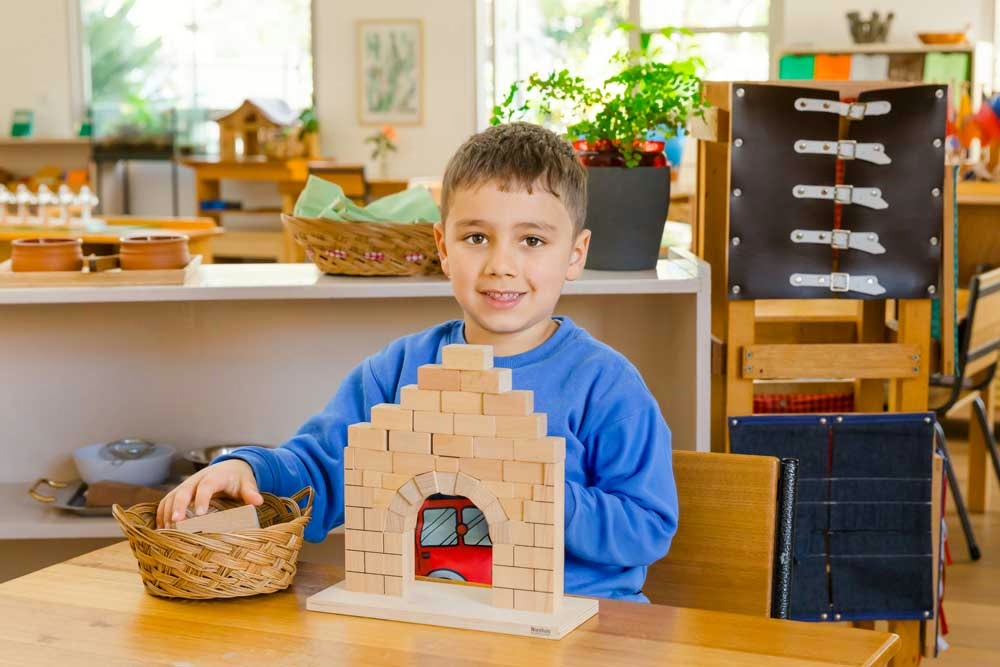
Children who have come through our Kinder program arrive in Prep having already spent time exploring mathematical concepts in a very hands-on way, building a strong understanding of quantity, pattern and relationships well before numerals enter the picture. For children joining us in Prep for the first time, that same journey happens, but it’s just a little more concentrated.
In a Montessori classroom, that understanding is built through movement and physical experience, because for young children, the connection between the body and the brain is how learning becomes lasting.
What this means is that by the time a Prep child is working confidently with numbers, they actually know what those numbers mean and are ready to progress through the curriculum. As Noemie puts it, “maths begins with understanding, and once that understanding is there, children move forward with real confidence.”
And that confidence builds quickly. A Prep child who has built those foundations will often begin exploring mathematical concepts from the Year 1 and 2 curriculum, because the groundwork has been laid and the next steps feel natural.
That progress is rooted in genuine comprehension rather than memorisation.
4. How will my child learn to think, not just complete tasks?
There is a difference between a child who is simply finishing work and one who is genuinely absorbed in what they are doing.
Noemie says early signs of independent thinking include children choosing their own work and committing to it, trying again when something is hard and noticing when something is not quite right and going back to fix it.
“They feel proud when they complete a task and that pride is real and it matters,” she says.
When children are given uninterrupted time to repeat an activity, sit with a problem and to keep returning to something until it feels right, they then begin to make decisions about their learning, rather than waiting to be directed. That internal drive is one of the most valuable things a Prep year can build.

5. How does the program support my child’s social and emotional development, not just their academic learning?
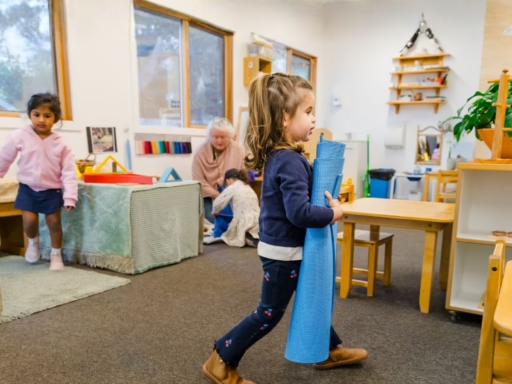
Alongside literacy and numeracy, children in Prep are learning something just as important: how to be part of a community. Learning how to wait, how to help and how to take responsibility for shared spaces, are all valuable skills that work towards preparing children for life.
Learning how to wait, how to help and how to take responsibility for shared spaces, are all valuable skills that work towards preparing children for life.
Such skills are taught through the Grace and Courtesy curriculum that is an integral part of Montessori, to help build awareness of self and others. They are further reinforced through the rhythm and every day moments of classroom life.
For example, children who care for their environment, who notice when a classmate needs a hand and who keep going when something is difficult, are building skills that will serve them throughout a lifetime.
Research into Montessori education has consistently found that children in Montessori settings outperform their peers not only in literacy and numeracy, but also in creativity, social understanding, enjoyment of learning and overall wellbeing at school.
A landmark study by Lillard et al., Montessori Preschool Elevates and Equalizes Child Outcomes, found these differences to be both meaningful and lasting, reflecting something fundamental about what the right environment makes possible in the early years.
Choosing the best prep program for your child is not about finding the most advanced starting point. It is about finding a place where your child can build genuine confidence, develop independence, and begin to trust their own ability to learn.
Those foundations endure long after Prep is a memory.