Montessori early learning and the power of movement
- Resources
At Melbourne Montessori College, our Montessori Early Learning program celebrates movement as a powerful tool for developing independence and confidence.
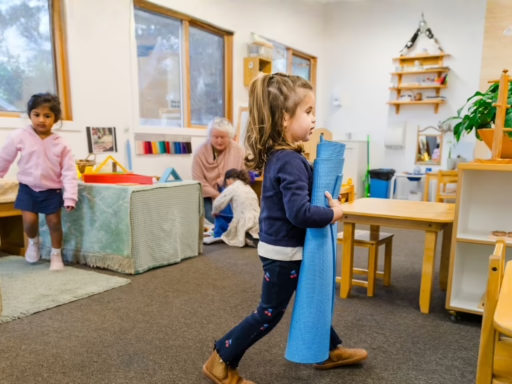
The Montessori early learners classroom is a fascinating place where early learners explore and move with purpose.
In Leanne Tarran’s early learners classroom at Melbourne Montessori College, some of the school’s youngest children are always on the move. But it’s not just movement for movement’s sake.
Whether they are crawling, walking, running, carrying, stretching, pouring water or learning how to safely cut a piece of fruit, each action places a child in deeper touch with their environment, so they can better understand the world around them.
“I have a small watering can in my classroom that is kept a long way from the plants in their pots. So, when a child wants to water the plants, they have to carry the watering can to the water tank, fill it but with not too much water at once, and then carefully walk across the room to water the plants. They have to think about their posture, balance and where they are stepping,” says Leanne, MMC’s Early Learner Educator.
“Once they’ve watered the plants, they must put the watering can back in its place. Each of these actions involves children moving around and through the room in a meaningful way. Their movement also recognises the autonomy and independence of a child and as they move, they are also considering themselves and their place in the classroom, the people around them, and their environment.”
From the Early Learning years and beyond, the Montessori approach helps even the youngest members of the school community to do things for themselves as much as possible. Carefully designed activities and equipment, such as a small water tank and drinking glasses positioned down low so children can reach and get their own glass of water, and ‘safe but real’ knives for cutting and chopping, foster a sense of agency and independence.
“In Montessori classrooms meaningful movement is linked with the development of independence, skills and an understanding of the world. Every element of a young child’s physical and cognitive development is connected.” explains Leanne.
“Each child is drawn to different activities and, along the way, they do things with their hands, develop grip and hand-eye coordination and also develop their mind. We say that the hand is the instrument of the mind.”
There are more than 50 choices of Montessori activities for early learners that each promote and enhance fine and gross motor skills. This can include activities such as threading beads, completing puzzles, using a spoon to transfer objects between bowls, posting, opening and closing containers, twisting, pouring, scooping, and building. At times, these movements are combined in a larger task—such as making playdough—while in other instances, they are practiced individually, allowing the child to repeat them with focused intent and purpose.
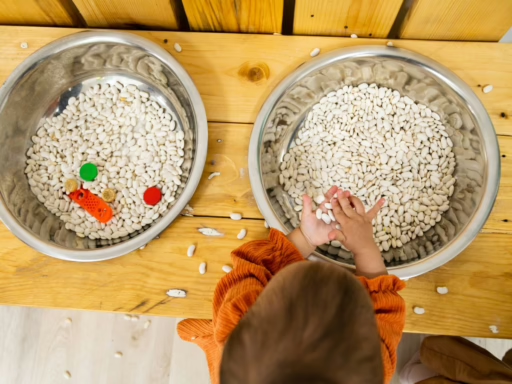
“At the youngest age, children are fascinated by small things and as they learn to post, pour, thread and spoon, they develop their fine motor skills and this kind of work helps them prepare to later hold a pen or pencil and to write,” says Zuzana Pacak, MMC Playgroup Leader.
“In Montessori early learning, fine and gross motor skills go hand in hand. The children go outside and run and jump, they carry things, they roll up a mat and hold things. They learn through movement and they learn better when they are ‘doing’, not only listening. The more children repeat a movement, the smoother it becomes and the less it requires conscious effort.”
The Montessori Early Learning environment is all about encouraging children to move, to recognise what they can do and to explore their growing independence. The spaces allow time and opportunities for children to choose how they move and what activities they take part in, with the Montessori educators ready to help and guide, just enough, when some assistance is needed.
“Building freedom and meaningful movement into a child’s world is a beautiful way to support their development and learning,” says Leanne.
About Our Montessori Early Learning Programs (18 months – 3 years)
Melbourne Montessori College offers two rich and nurturing early childhood programs designed to ignite a love of learning from the very start. Our Parent & Toddler Program, led by Zuzana Pacak, supports children aged 18 months to 2½ years as they begin to explore the world around them alongside a parent or carer. Our Montessori Early Learners Program, guided by Leanne Tarran, welcomes children aged 2½ to 3 years into an environment tailored for independence, expression and foundational skill-building.
Both programs offer carefully prepared Montessori environments where language development, emotional connection and purposeful play go hand in hand. From matching cards to naming objects, or simply taking quiet time to process the world around them, our youngest learners are supported to grow into curious, confident communicators — ready for the journey ahead.