Why Montessori teens become lifelong problem-solvers
- Resources
In today’s fast-changing world, being a good learner isn’t just about absorbing information. It’s about knowing how to adapt, think critically, and solve problems.
Whether it’s climate change, misinformation online, mental health, or AI ethics, the challenges facing young people are complex, cross-disciplinary, and constantly evolving. That’s why we don’t just teach students what to learn at MMC.
We teach them how to learn.
Which is how Montessori teens become lifelong problem-solvers.
The Third Plane: montessori teens Thinking Deeply, Acting Purposefully
During adolescence (ages 12–18), Montessori teens enter what Maria Montessori called the “Third Plane of Development.” At this stage, they begin to:
- Think more abstractly
- Question the world around them
- Develop a strong sense of social justice and moral reasoning
- Seek purpose and independence
In a Montessori setting, these needs are met through inquiry-based learning, freedom within limits, and a thoughtfully integrated curriculum that connects learning to real-world experience.
Maria Montessori once said, “The greatest sign of success for a teacher is to be able to say, the children are now working as if I did not exist.” At MMC, this philosophy shapes the way adolescents explore ideas and pursue purposeful learning.
Inquiry-based learning
Inquiry-based learning encourages students to explore meaningful questions, test ideas, and reflect on their discoveries. Rather than memorising content for a test, students might investigate the environmental impact of fast fashion, research alternatives, and present a proposal for change.
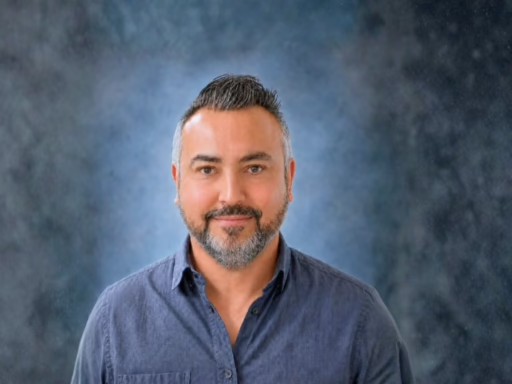
Principal Daniel Thomas says this is where motivation grows strongest: “When students drive the questions, they also drive the motivation. I’ve seen projects where sustainability, design, and economics overlap, and the students are not just learning – they’re problem-solving with a sense of urgency and purpose.”
He believes that when curiosity shapes the learning, students naturally begin to see themselves as capable thinkers with a responsibility to act.
Freedom within limits
Freedom within limits gives students genuine choice in how they approach their work, while still working within clear expectations. For example, a student preparing a project on renewable energy might choose to present their findings through a podcast, a model prototype, or a visual campaign. This balance builds ownership, self-regulation, and motivation. All of these are key traits for lifelong learning.
According to Daniel, genuine choice often leads to creativity that teachers could never predict. He notes that Montessori teens do not look for shortcuts; instead, they surprise their teachers by exceeding expectations in ways that are highly personal. “What I notice most is that when students are given real choice, they surprise us,” he explains. “They don’t just meet expectations, they often exceed them in ways that are creative and deeply personal.”
Integrated curricula
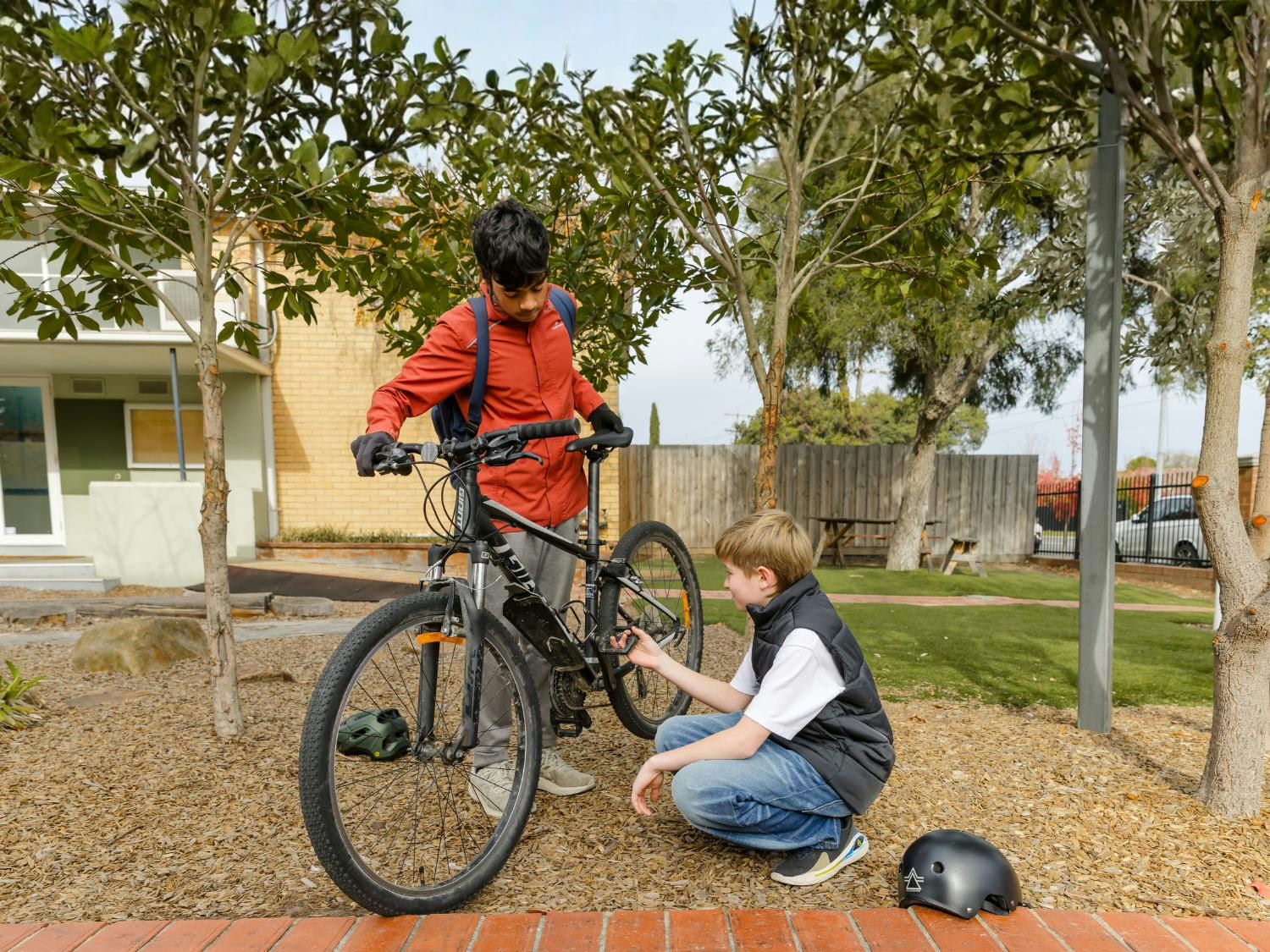
Integrated curricula are brought to life through MMC’s Occupations program, which currently includes horticulture, hospitality, bike education, textiles and fashion, theatre production, coding and robotics, and content creation.
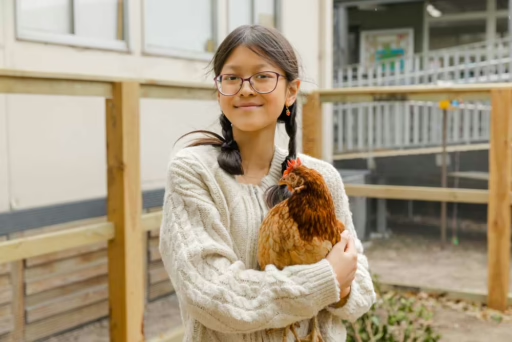
Montessori teens care for chickens in the horticulture space, collect eggs for use in the hospitality kitchen, and return food scraps to the compost to nourish the garden. This practical, sustainable cycle links biology, systems thinking, and environmental ethics. Other Occupations include fashion and textile design, where students explore creative expression and product development, and robotics and coding, where abstract thinking meets hands-on problem-solving.
Daniel points out that this is where the richest connections are made. He has seen a project that began in horticulture flow into hospitality or design, proving that boundaries between disciplines are more flexible than students often expect. “It’s in Occupations where you see the real connections being made,” he says. “Students don’t see boundaries between disciplines, they see opportunities.”
Scenarios that matter: real problems, real thinking
Here are just a few of the problem-solving opportunities MMC students might tackle:
- Social justice and ethics: In an IB Theory of Knowledge unit, students might ask: “Is it ever ethical to withhold scientific knowledge?”
- Data and misinformation: In Humanities, students could analyse how misinformation spreads online and design campaigns to build digital literacy.
- Environment and innovation: In Occupations, students might design a sustainable school garden, calculate the carbon impact, and propose a funding model.
- AI and creativity: In English or Visual Arts, students might compare AI-generated work with human expression to ask: “What makes creativity uniquely human?”
These scenarios demand not just subject knowledge, but collaboration, research, ethical reasoning, and communication.
What it all leads to
According to the World Economic Forum’s Future of Jobs Report, the top skills needed by 2025 include analytical thinking, complex problem-solving, resilience, active learning, and creativity. These are not rote skills, but habits of mind cultivated through intentional practice in environments that prioritise independence, reflection, and real-world relevance.
Daniel notes that MMC students do not leave school with just the ability to pass exams. Instead, these Montessori teens leave with the skills and mindset to adapt.
“Our students don’t just leave school ready to pass exams,” he says. “They leave ready to handle ambiguity, to challenge assumptions, and to keep learning for life.”