How Montessori builds confidence from the inside out
- Resources
Confidence is not something that can be handed to children. Montessori builds confidence step by step, through meaningful experiences, opportunities for independence, and gentle guidance at just the right moment. In Montessori classrooms, this is described as “following the child” — recognising each learner as an individual with their own pace and potential.
Maria Montessori captured this idea when she wrote, “Free the child’s potential, and you will transform them into the world.” Her words continue to guide classrooms today, where children are supported to grow into capable, resilient, and self-assured learners.
What ‘Following the Child’ Really Means
In a Montessori setting, teachers act first as careful observers. They notice when a child is ready for a new challenge, introduce lessons at the right moment, and then step back to let learning unfold. This individualised approach ensures that confidence is built on genuine achievement rather than comparison with others.
Kate Ding, Cycle 1 Guide and Educator at MMC’s Caulfield Campus, describes this process: “I step in with gentle guidance when a child asks for help, offering just enough support to keep them moving forward. Once the child shows confidence and comfort with the task, I step back and allow them to work independently, observing closely to ensure they’re progressing and ready for any further support if needed.”
Building Confidence in the First Plane of Development (Ages 3–6)
In the First Plane of Development, children learn through their senses and absorb knowledge from their surroundings. Practical life activities such as pouring their own drink, caring for plants, or putting materials away build independence and a sense of competence.
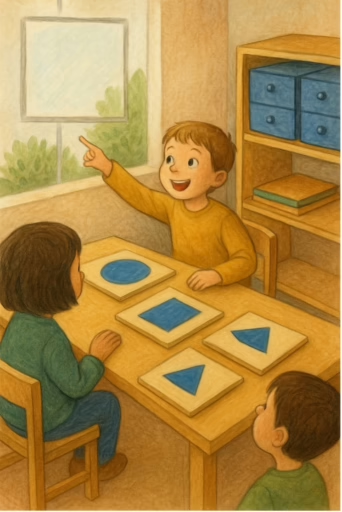
Kate recalls a moment in her classroom that showed how Montessori builds confidence and how that confidence grows in these years. After practising with the geometry cabinet shapes, a child suddenly pointed to the window and exclaimed, “That is a square! And the other one is also a square!” Then, spotting a plate, he added, “This is a circle!” It was a joyful moment of recognition, as he began applying classroom learning to the world around him.
Experiences like these — tying shoelaces, pouring water, or naming geometric shapes — help children build an inner voice that says, “I can do this.” That voice becomes the foundation for resilience and independence in the years ahead. This is how Montessori builds confidence.
Confidence Beyond the Early Years – The Second Plane (Ages 6–12)
By around the ages six and seven, children enter the Second Plane of Development. Here, their confidence evolves. While independence remains important, they also begin seeking intellectual challenges, working in groups, and asking deep “why” questions.
The trust and independence developed in the early years carry forward. Now, that confidence allows them to:
- Plan and lead group projects
- Take on class responsibilities
- Mentor younger students
- Present their work to peers or the wider school community
Kate explains that this continuity is central to Montessori learning and how Montessori builds confidence. Skills nurtured in the First Plane (such as problem-solving and persistence) prepare children to take on more complex challenges in the later primary years.
Five Signs Your Child Is Thriving in a Montessori Environment
Confidence can be hard to measure, yet it reveals itself in everyday actions. In Montessori classrooms, teachers see it not only when children master a new skill, but also in the way they approach challenges, interact with peers, and take joy in their discoveries. Parents, too, can notice these signs at home.
You may notice your child thriving in a Montessori environment when:
- They show independence in daily routines and take initiative in self-care and school tasks.
- They are able to focus deeply on chosen activities and sustain concentration for long periods of time.
- They demonstrate resilience after mistakes and begin to see errors as opportunities to learn.
- They approach challenges with initiative, generating their own ideas and solutions rather than waiting for instructions.
- They find joy in learning and share their discoveries with enthusiasm and pride.
Kate notes that these qualities don’t appear overnight. They are nurtured through the prepared environment, where every element, from trained adults to carefully chosen materials, is designed to give children the confidence to act, explore, and contribute.
Why it works for the whole Junior School
Confidence is not taught in a single lesson. It is cultivated over years. By following the child, Montessori education ensures that whether they are learning to tie a bow at age four or leading a science project at age ten, children are given the right level of challenge at the right time.
The result is a child who leaves Junior School with not only academic knowledge but also the self-belief to approach life with curiosity, resilience, and courage.
Montessori’s principle of “following the child” ensures children become capable, resilient, and self-assured learners for life.